

When Pigs Fly
On hostile skies, shrinking cabins, and the price of taking up space
“Come fly the friendly skies” once sounded expansive. Not luxurious, not egalitarian, but expansive in the sense that the system was built to carry human bodies with at least a baseline of dignity. Even in economy, you were transported rather than processed.
That sense of expansiveness narrowed alongside the industry itself. After airline deregulation in 1978 intensified price competition, carriers began reorganizing their business models around yield, load factors, and revenue per available seat mile. Those are abstract terms until you are sitting in 17 inches of width with your shoulders angled inward to avoid brushing a stranger. The aircraft did not shrink, but the interior was repeatedly redesigned to fit more seats into the same shell. Pitch tightened. Width narrowed. Personal space became negotiable because profit margin was not.
Passengers complained, and the complaint was correctly aimed. Airlines were criticized for compressing the cabin in pursuit of profit. The indignity of modern flying was understood as a structural outcome of density strategies. The villain was corporate optimization.
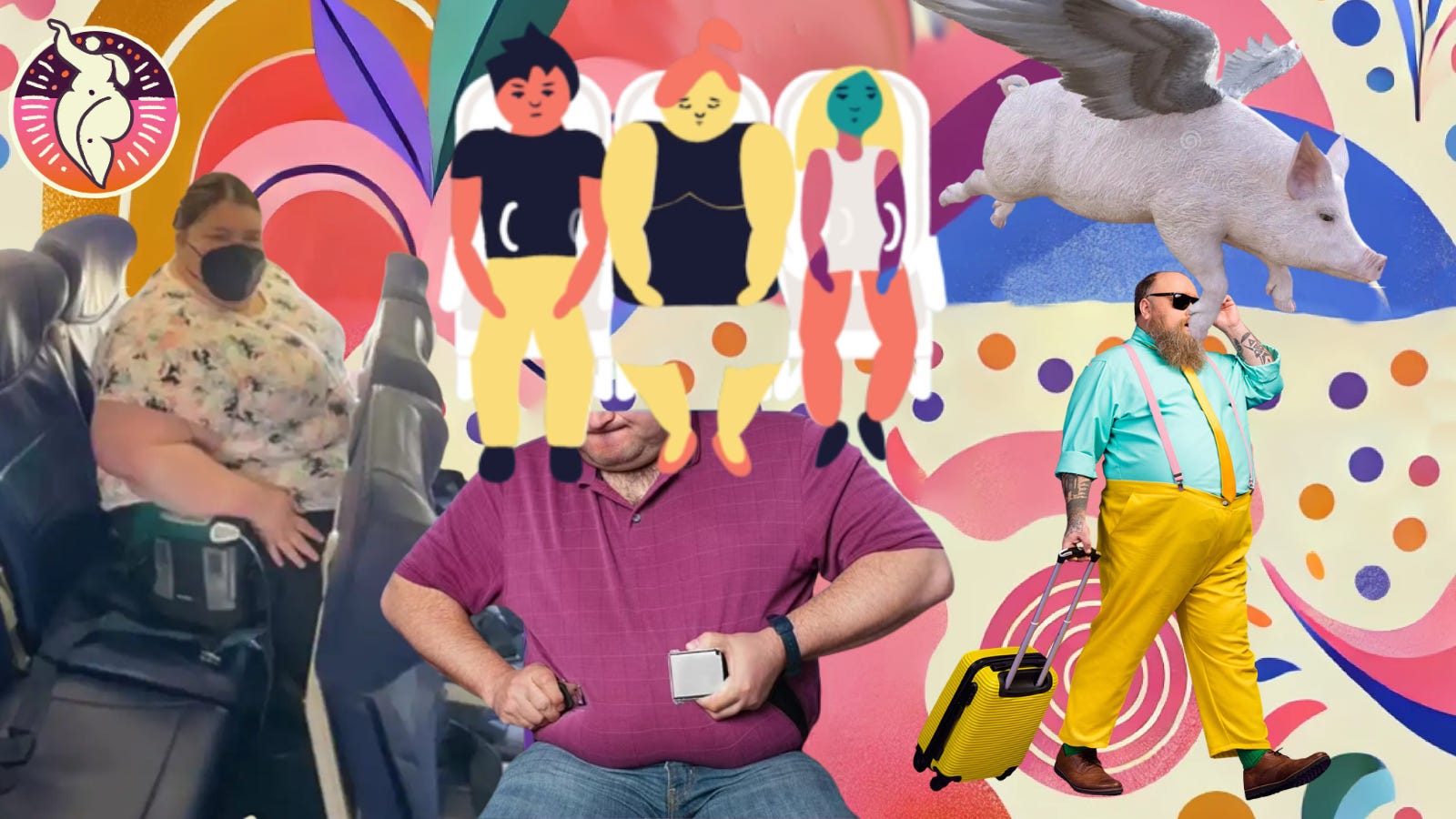
Southwest Airlines built its brand during that era by presenting itself as the humane alternative. From open seating to friendly crews, their tone implied accessibility rather than hierarchy. When Kevin Smith was removed from a Southwest flight in 2010 under its Customer of Size policy, the backlash was loud enough to force a recalibration. Southwest responded by clarifying that larger passengers were welcome and that additional seating could be arranged without automatic financial penalty. For years afterward, fat travelers described Southwest as comparatively safe because the airline appeared willing to absorb some of the logistical friction created by shrinking space rather than immediately pushing it onto the passenger.
That posture has changed. Dramatically.
With the move to assigned seating, Southwest Airlines has changed who carries that burden. Under the updated approach, if a passenger is deemed to need a second seat, Southwest no longer simply provides that seat at the airport when one is available as part of a discretionary accommodation. The passenger is expected to purchase it. Or else. Refunds may still be possible under specific conditions, but they are not guaranteed, and the cost must be fronted by the traveler.
If they cannot meet the cost of the extra seat, they cannot fly. If they cannot accept these conditions, imposed by attendants and supervisors alike, they can be escorted from the terminal and prohibited from further flights.
Southwest continues to frame this new policy in the language of “comfort” and preventing encroachment. Presented that way, it sounds like it could be a neutral boundary rule.
Read in isolation, “comfort” sounds unimpeachable. No one wants to be pressed into a stranger for hours. No one objects to boundaries. The armrest offers a visible line.
The framing presents this policy as fairness.
What disappears is how radically the narrative has shifted.
We discussed how people constantly complain about airline travel, and the indignity of modern flight. But importantly, that the anger was directed upward. Towards our corporate overlords.
Once your comfort is framed as something threatened by the neighboring passenger rather than by the very design of the cabin itself, the direction of that anger moves. The airline’s “density strategy” fades into the background.
The body becomes the target of the anger.
Instead of saying airlines stripped dignity from flying, we begin suggesting that certain bodies are responsible for its absence.
That shift protects the structure that created the compression. It relocates responsibility from corporate policy to individual flesh. The cramped experience that everyone feels is now embodied by the fat passenger, who becomes the human symbol of the indignity everyone resents.
And the enforcement of that shift is not neutral.
Flying has already trained passengers to expect commodified scrutiny. We have been conditioned to slide our bags into metal frames and accept that if they do not fit, we pay. That grift at least involves an object that can be measured against a device designed for that purpose. The bag either fits the sizer or it does not.
There is no universal model seat that every passenger must sit in before boarding. There is no objective apparatus that applies equally. The determination happens in real time, at the counter or at the gate, sometimes while boarding is underway. A person in uniform looks at another person’s body and decides whether it exceeds the acceptable dimensions of the cabin. If it does not, the solution is financial.
It might be less dehumanizing if there was a sizer. But instead there is only visual assessment and discretionary judgment attached to revenue. The transition from being charged for our luggage to being charged for our flesh feels seamless because the logic is the same. Space is scarce. Scarcity is monetized.
The difference now is that the object being evaluated isn’t luggage… it’s you.
The cabin is uncomfortable for many reasons. Some passengers are tall enough that their knees press into the seat ahead or into the aisle. Some have shoulders that extend beyond an armrest. Some carry scents that linger for hours. Some fall asleep and lean. Some watch videos with no headphones. Some claim both armrests without apology. None of these conditions are converted into formal surcharges. They remain part of the messy, negotiated reality of shared space on a plane.
Fatness alone is codified.
Only one kind of discomfort is written into policy and translated into a fee.
Only one kind of body is formally designated as the encroachment problem.
The humiliation is embedded in the timing. Instead of being resolved in advance through a predictable process, the issue can arise during boarding itself, when some random employee has the authority to decide whether your presence requires an extra fee before you are permitted to take your seat. The crowd waiting to board becomes an audience to the conversion of your body into a surcharge.
On paper, the policy presents two paths. You can buy a second seat in advance and hope you meet the criteria for reimbursement, or you can proceed to boarding and accept that a gate agent may determine in real time that you need to pay. In either case, the premise is the same: your presence in the space is conditional.
In a culture that already treats fatness as moral failure, this policy does not land on neutral ground. Weight stigma is already woven through healthcare, employment, and media, and research has documented that perceived weight discrimination is associated with adverse health outcomes independent of BMI, including increased mortality risk. When an airline narrows seats in pursuit of density and then frames fat bodies as the encroachment problem, the economic decision fuses with a cultural narrative that casts those bodies as excessive and blameworthy.
The result is that fat passengers become the human embodiment of a dignity-free flying experience that was engineered long before they boarded. The compression everyone feels is real, but instead of tracing it back to deregulation and profit metrics, the system offers… a simpler culprit.
It offers a body.
A fat body.
A fat body that we, as a society, have decided must pay.
If this sounds familiar, it should. I have written before about how structural harm is often reinterpreted as individual defect in pieces like “The Chronic” and “Ozempidemic,” where public health frameworks quietly relocate systemic decisions onto personal responsibility. The pattern is the same here. Infrastructure is treated as fixed. Bodies are treated as adjustable.
Southwest’s original reputation rested on the promise that flying with them would feel less hostile. The new posture feels like a turn not just in logistics but in tone, as though the friendliness extends only as far as your ability to compress yourself into dimensions that were tightened in the name of efficiency. And if we accepted the airlines grifting us about our bags, it was only time before they started grifting us about our bodies.
The skies did not become cramped because fat people started flying. They became cramped because deregulation incentivized density and density was profitable. When the discomfort of that choice is reassigned to the bodies that cannot invisibly absorb it, we are no longer talking about comfort. We are talking about scapegoating.
And that is a very different flight path.