

Tree Trunk Legs
What lipedema taught me about fatphobia, family, and the stories we tell ourselves
I grew up being told I had “tree trunk legs,” the way my mother did and her aunt and the female cousins before me, a burden we had to bear as a family. I was taught early that it meant my legs were something to be hidden so I should not wear shorts or skirts that did not come down to my ankles. You think some little girls’ shorts are too little? Well, that wasn’t a problem I was experiencing. I was like a little Amish girl instead.
I remember being about thirteen or fourteen and going to a dance and my dad’s girlfriend had helped me pick a dress, a cute red flirty thing that swirled and twirled about four inches above my knees. I was feeling so pretty and I had had my hair done, and then I came home to my mother’s house where she told me the dress revealed my legs too much, how disgusting they were, and I remember crying. I had broken the cardinal rule.
I lamented that I had “cankles” even as a young girl, and it didn’t help that I went to an all-girls school where the other girls would tailor their uniform skirts so high. Their legs were so shapely and smooth, while mine were just awful. I could not help but notice that my legs were different from everyone else’s, and I blamed myself because I was seemingly the only one in a class of 33 girls.
I did not wear shorts, even on the hottest days, even at the beach, until I was in my 30s. I got poison ivy three summers in a row as a pre-teen and it was made SO much worse because my long pant legs would stick to the pus and spread the infection.
So many of my core memories revolve around being ashamed of my extremities. I remember being in my 20s, wearing a sleeveless shirt, and having some idiot dude comment on how big my arms were, joking that I was “jacked” and that I was going to mug him.
I tell you this because this is what living in a fatphobic society does to a person, especially when your body does not conform to the story everyone else tells about why bodies look the way they do.
Our culture has a core set of beliefs about weight that run deep: that being fat is your fault, that it is about self-control and willpower, that it is as simple as calories in and calories out, and that if you just tried harder or ate less or moved more you would be thin and if you are not then you must not be trying hard enough.
No one wants to hear that there could be hormonal influences or genetic ones. The narrative is simpler than that and more punishing: your body is a reflection of your moral worth, and if it is large, you have failed. I wrote about how children absorb this logic long before they have language for it in “The True Lessons of Augustus Gloop,” and it keeps circling back to the same question: what happens when the story we tell ourselves about bodies is wrong?
Here is where lipedema comes in.
It affects about 11% of women worldwide, roughly 1 in 9 adult women, approximately 460 million women globally (Buck & Herbst, 2016). It is a condition where fat accumulates symmetrically and disproportionately in the legs and sometimes the arms, and it causes pain and easy bruising and has a distinct nodular texture, and it typically spares the hands and feet, which is one of the ways doctors distinguish it from ordinary obesity and lymphedema even though it is constantly mistaken for both.
There is another layer to this.
The fat accumulates in the legs and the buttocks, in the hips and the thighs, the very places that our culture tells us make a woman's body a woman's body. Lipedema follows a gynoid distribution pattern, the same fat distribution driven by estrogen that gives women their characteristic shape (Torre et al., 2018). This is fat that lands exactly where female hormones tell it to go, only more so, only painfully, only in a way that gets pathologized rather than celebrated. We are shaming women for having bodies that look, in some sense, too much like women's bodies.
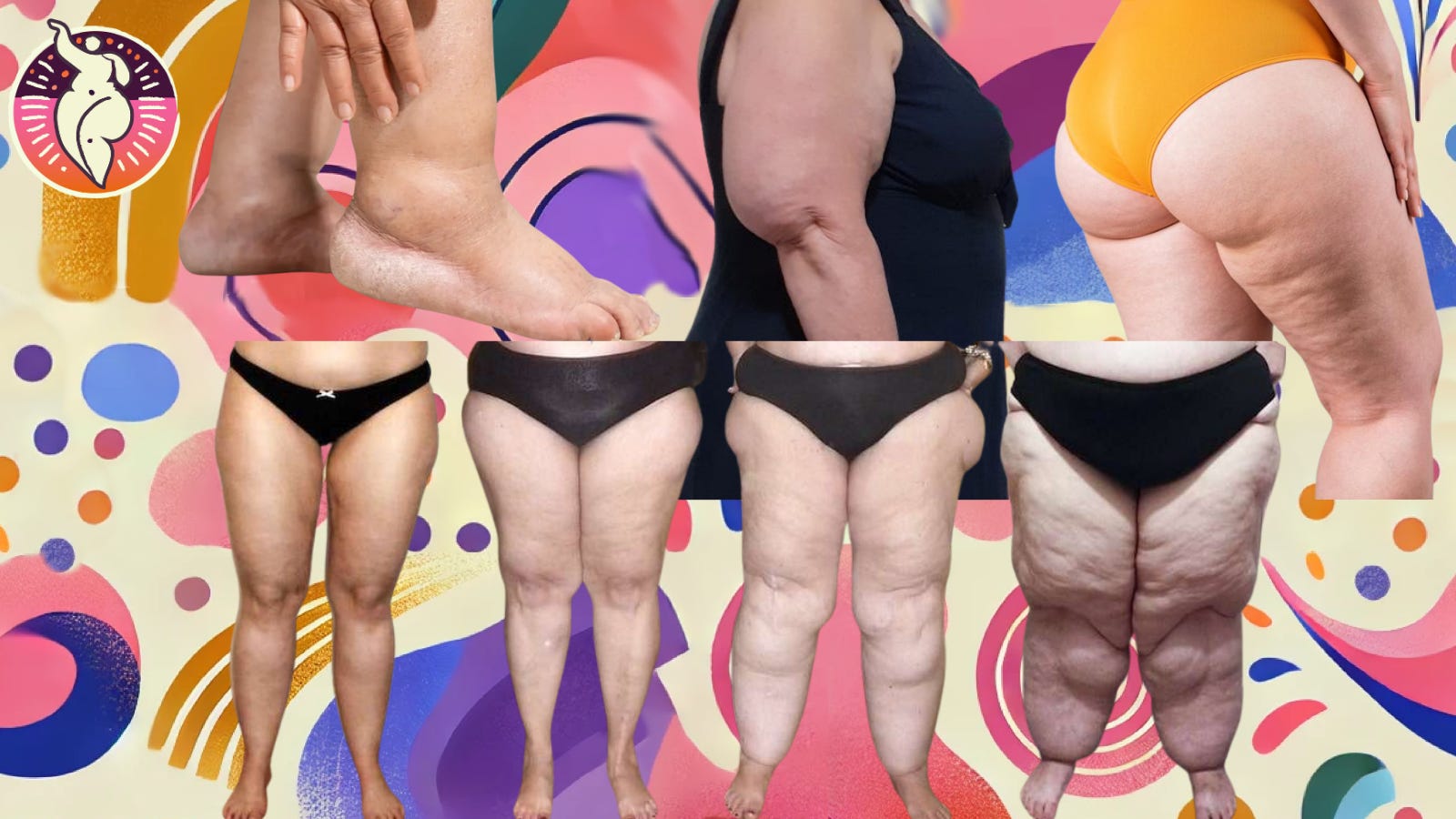
Here is the part that really challenges everything we think we know: the fat does not respond to diet or exercise or calorie restriction or bariatric surgery (Buck & Herbst, 2016). The tissue itself is different from ordinary body fat, more inflamed and more fibrotic, and it simply does not shrink with weight loss (Cifarelli et al., 2025). Women with lipedema also tend not to have the usual metabolic problems that the culture has (often erroneously) associated with obesity; they are less likely to develop type 2 diabetes, high blood pressure, or high cholesterol.
It runs in families and almost always shows up during hormonal shifts like puberty, pregnancy, or menopause (Child et al., 2010). It affects women almost exclusively, and it has been described in the medical literature since 1940.
Despite affecting roughly 1 in 9 adult women, lipedema remains largely unknown to the very people who should be diagnosing it. One study found that only 46% of UK vascular specialists surveyed could even recognize the disease (Faria et al., 2025). Less than half of these DOCTORS could recognize it.
I see it now in women around me, in the cuffing at their ankles or their upper arms, in the column shape of their legs, in the way they describe the pain and the bruising and the texture they have spent their whole lives apologizing for. If I, a person with no medical training, can recognize it, how is it that doctors miss it in woman after woman who walks through their doors?
And in a more recent study of 508 medical doctors, while 51% were familiar with the term, only 29.9% had actually seen or referred a patient with it while more than half had no idea about its clinical features or treatment options.
So what happens to the millions of women who have it is that they get told they just have big legs and they are not trying hard enough to lose weight?? They are frequently just told that they are obese and subjected to unnecessary medical interventions and profound psychosocial distress (Buck & Herbst, 2016).
The average time from symptom onset to diagnosis, according to one study, was 15 years (Ghods et al., 2025).
Fifteen years of being told it is your fault that your legs and arms are fat.
This is not just a medical problem. It is a feminist one: a disease that almost exclusively affects women, that involves fat distribution and hormones and genetics, (all things the medical establishment has historically been terrible at taking seriously,) is dismissed and underfunded and understudied while the women who have it are shamed by their families and their doctors and the culture at large for bodies they did not choose and cannot change through willpower.
The mechanism that makes a disease that affects 1 in 9 women invisible is the same one that taught me my legs were disgusting. We accept without question that some people get cancer or develop autoimmune diseases or have conditions beyond their control, but when it comes to fat, even fat that behaves demonstrably differently from ordinary obesity and is painful and runs in families and resists calorie restriction, the cultural presumption of fault is nearly impossible to overcome.
I need to be careful here, because this is where the conversation gets uncomfortable. When I say lipedema fat is not your fault, it can sound like I am implying that regular obesity IS your fault, and I want to be clear: that is not what I believe.
If THIS disease can cause fat to accumulate in ways that resist diet and exercise, is genetic, and responds to hormones, then the obvious question is: what else might be invisible that causes people to live in bigger bodies that doesn’t fit our cultural expectations of obesity?
Lipedema does not prove that all obesity is biological, but it does prove that the story we tell about weight, that it is purely a matter of personal responsibility, is incomplete at best.
If ~500 million women have a condition that makes a mockery of that narrative, how many more people are suffering under a framework that was never designed to account for the complexity of human bodies?
I see lipedema everywhere. Yet when I talk to women about it, they do not even know it exists. They have spent their whole lives thinking their legs were just ugly and just wrong and just their fault, and they were never told that there is a name for what they have or that it is real or that it is a disease or that it is not some physical manifestation of their personal failings.
It is June and it is Lipedema Awareness Month and I want you to be aware about this disease, and I want you to understand that our culture’s story about weight, that it is all about calories and willpower and personal responsibility, is incomplete at best and cruel at worst.
That a disease affecting 1 in 9 women that defies our culture’s narrative about fat completely is something that most people have never heard of. We need better research and doctors who know how to recognize it and a culture that stops blaming women for their bodies. Most of all, we need to listen to the women who have been telling us this all along, that their bodies are different, and finally, finally believe them.
Do you think you might have lipedema? There are resources online here
References
Buck, D. W., & Herbst, K. L. (2016). Lipedema: A relatively common disease with extremely common misconceptions. Plastic and Reconstructive Surgery Global Open, 4(9), e1043. https://doi.org/10.1097/gox.0000000000001043
Child, A. H., Gordon, K., Sharpe, P., Brice, G., Ostergaard, P., Jeffery, S., & Mortimer, P. (2010). Lipedema: An inherited condition. American Journal of Medical Genetics Part A, 152A(4), 970-976. https://doi.org/10.1002/ajmg.a.33313
Cifarelli, V., Smith, G. I., Gonzalez-Nieves, S., Samovski, D., Palacios, H. H., Yoshino, J., Stein, R. I., Fuchs, A., Wright, T. F., & Klein, S. (2025). Adipose tissue biology and effect of weight loss in women with lipedema. [Imported document in Lipedema folder.]
Faria, A. M., Valerio, C. M., Barcellos, C. R., Oliveira, R. A., Trujilho, F. R., Baiocchi, J. M. T., Cifarelli, V., Scherer, P. E., & Halpern, B. (2025). Unraveling lipedema: Comprehensive insights and the path to future discoveries. [Imported document in Lipedema folder.]
Ghods, M., Georgiou, I., Schmidt, J., & Kruppa, P. (2025). Disease progression and comorbidities in lipedema patients: A 10-year retrospective analysis. [Imported document in Lipedema folder.]
Szel, E., Kemeny, L., Groma, G., & Szolnoky, G. (2014). Pathophysiological dilemmas of lipedema. Medical Hypotheses, 83(5), 599-606. https://doi.org/10.1016/j.mehy.2014.08.011
Torre, Y. S., Wadeea, R., Rosas, V., & Herbst, K. L. (2018). Lipedema: Friend and foe. Hormone Molecular Biology and Clinical Investigation, 33(1). https://doi.org/10.1515/hmbci-2017-0076
I recognize that having a bigger body does not always equal a lack of willpower. Thank you for debunking the myth.
Thank you for writing this! I don't have lipedema but can see it must be so difficult to navigate. A lot of what you have written was the same for me as well with being obese - I didn't realise it was my genetics and not just a lack of willpower. I'm sure your writing will help others to feel seen and supported.