

Do You Actually Hate Your Body?
The outside-in psychology of body shame.
Here’s a thought I want you to sit with, even if it feels uncomfortable at first.
What if you don’t actually hate your body?
What if what you hate is what happens to you because of your body.
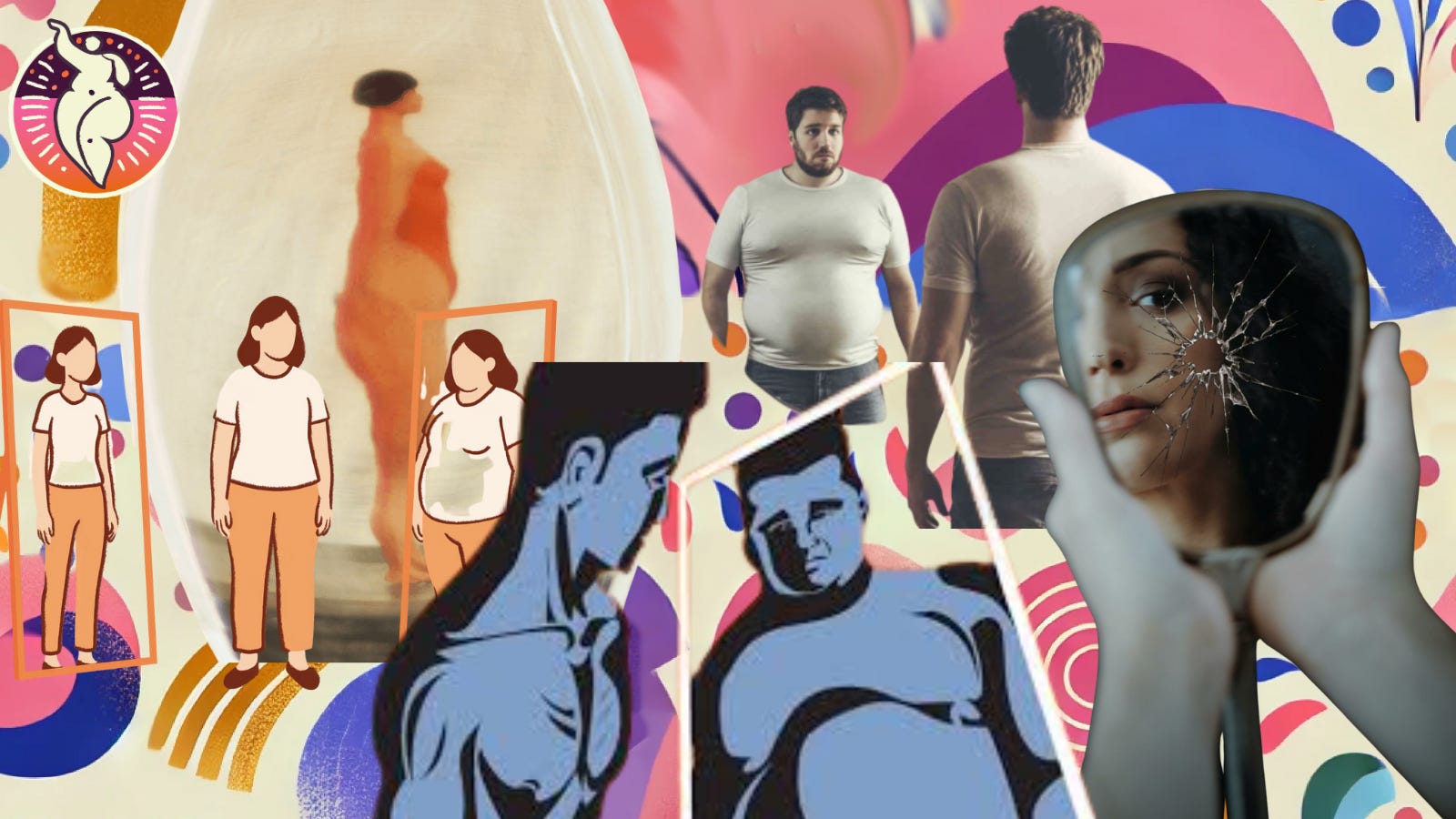
I keep coming back to this because when people talk about body dissatisfaction, they usually describe it as something deeply internal. A failure of confidence, or low self-esteem. Poor body image. A personal failure. Something personal and psychological, lodged somewhere deep inside the self.
But I don’t think that’s the whole story.
Because a lot of what gets described as “body insecurity” starts to look very different once you acknowledge that bodies do not exist in isolation from culture. Human beings learn from patterns. We learn from reward and punishment. We learn from observation. And we live in a society that delivers an extraordinary amount of messaging about which bodies are allowed to move comfortably through the world and which ones are not.
Nobody is born believing their round stomach is evidence of moral failure.
People absorb these ideas gradually, often so gradually that the lessons stop feeling like lessons at all. You overhear adults talking about food like morality. You watch weight loss get treated as a personal triumph regardless of context. You realize pretty quickly that thinness is associated not just with attractiveness, but with discipline, competence, desirability, self-control, even goodness. Entire industries exist to convince people that shrinking their bodies will also improve their lives, personalities, relationships, and futures.
After long enough, the messaging stops sounding cultural and starts sounding true.
I think part of why I resist the idea that body hatred is innate is because I have lived in places where the emotional meaning attached to bodies felt completely different.
When I was living in Kenya, I remember being startled by how differently my fatness was perceived. It was celebrated, fetishized. Bigger bodies like mine were not automatically treated as cautionary tales or evidence of personal failure in the way they are in white Western culture. That didn’t mean beauty standards disappeared or that nobody experienced body pressure, but the moral panic around fatness felt dramatically less all-or-nothing.
And that experience created a kind of dissonance for me, because it became much harder to believe that my discomfort around my body was some natural emotional truth, once I had seen how differently bodies could be interpreted in another cultural context.
The things we’ve been asked to believe as universal truths maybe… aren’t universal?
The lesson wasn’t that everyone everywhere loves fatness. The lesson was that these conclusions we draw about bodies are learned.
I wrote about this recently in The True Lessons of Augustus Gloop, because children’s media is one of the clearest places you can watch this conditioning happen in real time. Kids are not born believing fatness is embarrassing or immoral. They learn it through repetition. They notice which characters are mocked, which ones are lovable, which people are allowed complexity or desirability, and which bodies exist primarily as jokes, failures, inconveniences, or problems to overcome.
And honestly, adults are not as different as we would like to believe.
Researchers have been writing about this dynamic for decades. In objectification theory, Barbara Fredrickson and Tomi-Ann Roberts (1997) argued that women learn to internalize an observer’s perspective on their own bodies, monitoring themselves through the imagined gaze of others. Feminist scholars later described widespread body dissatisfaction among women as “normative discontent,” because dissatisfaction with the body had become so culturally expected that it was treated as ordinary.
Ordinary.
That word really sticks with me.
Because we live in a culture where openly disliking your body is often treated as evidence of self-awareness. People are reassured by it. A woman criticizing herself feels familiar. Normal. Ordinary. It signals that she understands the rules.
But a person, especially a fat person, who seems genuinely comfortable in their body tends to disrupt those expectations in ways people react to very strongly, particularly online. There is an enormous difference between a fat person saying, “I’m trying to love myself,” and a fat person simply existing as though their body does not require constant apology or correction.
The first version is understandable to people because it still follows the expected narrative. The body remains a problem that is being worked on. The second version unsettles people because it interrupts the idea that fatness is supposed to produce shame automatically.
And you can watch the reaction happen in real time. A fat person posts a photo feeling confident or attractive or joyful, and suddenly complete strangers start insisting they are “promoting obesity” simply by existing visibly without self-loathing. The body stops being read as a body and starts being interpreted as a statement that contradicts every bit of messaging culture has tried to normalize.
Which is part of what makes this so exhausting.
People act as though fat people becoming comfortable in our bodies represents some kind of social threat, when in reality it often just exposes how deeply everyone has been taught to associate thinness with virtue and fatness with failure.
I touched on this in The Quiet Cost of Celebrity Weight Loss, because one of the things that hurts so much about watching fat celebrities lose weight is not the individual choice itself, but the cultural reaction surrounding it. This collective sigh of relief that this fat person has finally been given the tools and the power to overcome their terrible fate. Fatness is only tolerated as a temporary condition, but remaining fat while happy or successful still seems to destabilize people in ways they rarely admit out loud.
Those narratives do not stay confined to celebrity gossip or internet commentary. They shape how real people understand fatness, including how they treat fat people in everyday life.
Research has found that weight stigma is associated with chronic stress, elevated cortisol levels, delayed healthcare, disordered eating behaviors, exercise avoidance, anxiety, depression, and future weight gain independent of baseline BMI (Tomiyama et al., 2018). Studies have also shown that people report experiencing weight discrimination at rates comparable in some contexts to racial discrimination in the United States (Puhl, Andreyeva, & Brownell, 2008). And people are treated differently when they are bigger. Not hypothetically. Materially.
Which means a lot of this distress is not appearing out of nowhere inside individual people. It is being produced and reinforced socially, over and over again.
Fat people are less likely to be hired, less likely to be perceived as competent, and more likely to have their pain dismissed medically. Fat children experience higher rates of bullying and social exclusion. Fat patients routinely delay medical care because they anticipate humiliation or dismissal before they even walk into the room. Research has repeatedly documented anti-fat bias among healthcare providers, educators, employers, and even family members (Tomiyama et al., 2018).
Which means people are not imagining the social consequences attached to body size. They are living them.
And I think that changes the conversation around body image quite a bit, because we tend to talk about body hatred as though it develops entirely from the inside out. As though people arrive at shame independently, through some private failure of confidence or self-esteem, instead of absorbing it continuously from the culture surrounding them.
Our culture is actually very good at disguising social conditioning as personal truth. It reframes punishment as wellness, especially for fat people. Restriction becomes discipline, while hunger becomes virtue. Distrusting your body becomes maturity and responsibility. Over time, self-surveillance starts getting interpreted as health itself.
Which is part of why I keep coming back to this question.
Do you hate your body?
Because when I look honestly at my life, most of my distress has never come from sitting alone in a room, hating my body in a vacuum.
It came from navigating the social meaning we have allowed to be attached to bodies. From learning, very early, which kinds of people were trusted, admired, interrupted, mocked, desired, medicalized, or ignored.
And once you understand that, the experience starts feeling much less like personal dysfunction and much more like adaptation to our environment.
…which does not make the pain less real.
But it does make me wonder how many people have spent years trying to fix themselves without ever stopping to ask whether the feeling they were trying to fix was entirely theirs to begin with.
References
Fredrickson, B. L., & Roberts, T. A. (1997). Objectification theory: Toward understanding women’s lived experiences and mental health risks. Psychology of Women Quarterly, 21(2), 173–206.
Puhl, R. M., Andreyeva, T., & Brownell, K. D. (2008). Perceptions of weight discrimination: Prevalence and comparison to race and gender discrimination in America. International Journal of Obesity, 32(6), 992–1000.
Tomiyama, A. J., Carr, D., Granberg, E. M., Major, B., Robinson, E., Sutin, A. R., & Brewis, A. (2018). How and why weight stigma drives the obesity “epidemic” and harms health. BMC Medicine, 16, 123.